
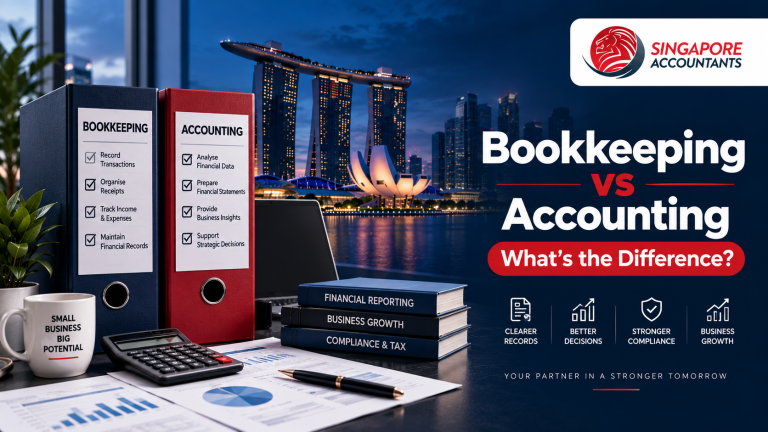
Bookkeeping and accounting are closely connected but distinct functions. Bookkeeping records daily financial transactions. Accounting analyses those records to explain financial performance and support business decisions.
For Singapore companies, both functions are essential for maintaining accurate records, managing cash flow and preparing reliable reports. SGA’s accounting and bookkeeping services Singapore combine both functions into one structured financial management process.
Bookkeeping records and organises financial transactions, including sales, purchases, receipts and payments.
What Is Bookkeeping?
Bookkeeping is the systematic recording of a company’s financial activities. Every transaction is entered into the correct account and supported by appropriate documentation. Typical tasks include:
- Recording sales and business income
- Entering supplier invoices and expenses
- Tracking customer and supplier balances
- Reconciling bank and credit card statements
- Maintaining the general ledger
- Organising receipts and supporting documents
- Recording payroll-related transactions
- Identifying missing or duplicated entries
SGA’s bookkeeping services Singapore clients keep records updated and organised throughout the financial year. Accurate bookkeeping simplifies monitoring unpaid invoices, managing upcoming expenses, and preparing information for tax and reporting purposes.
Bookkeeping is focused on historical transactions. It records what has already occurred.
What Is Accounting?
Accounting involves reviewing, interpreting, and reporting the financial information produced through bookkeeping. Accountants use these records to assess profitability, financial stability, cash flow, and overall business performance. Common responsibilities include:
- Preparing financial statements
- Reviewing income and expenses
- Processing year-end adjustments
- Analysing financial performance
- Preparing budgets and cash-flow forecasts
- Reviewing assets and liabilities
- Supporting corporate tax and GST preparation
- Advising management on financial decisions
SGA’s accountants in Singapore identify trends and issues that are not always apparent from transaction records alone, for example, revenue growth alongside declining profit margins caused by rising supplier or operating costs.
Accounting therefore has a broader, more analytical role than bookkeeping.
Bookkeeping vs Accounting: Key Differences
Area | Bookkeeping | Accounting |
Main purpose | Records financial transactions | Analyses and interprets financial records |
Primary focus | Daily financial activities | Financial performance and planning |
Common tasks | Data entry, reconciliations, ledger maintenance | Reporting, analysis and financial advice |
| Typical output | Updated books and transaction records | Financial statements and management reports |
Decision support | Provides organised financial data | Uses data to support business decisions |
Work frequency | Daily, weekly or monthly | Monthly, quarterly or annually |
Accounting depends on accurate bookkeeping. Missing or incorrectly classified transactions can lead to unreliable reports and conclusions.
How Do Both Functions Support Financial Reporting?
Once transactions are recorded and reconciled, accounting processes can turn the data into useful reports, including:
- Profit and loss statements
- Statements of financial position
- Cash-flow statements
- Aged receivables and payables
- Budget-versus-actual analysis
Does Your Business Need a Bookkeeper or an Accountant?
Most businesses benefit from both. The level of support depends on transaction volume, business complexity, and reporting requirements. Smaller businesses may primarily need reliable bookkeeping and reconciliations, while growing businesses often require management accounts, cash-flow forecasting and financial analysis.
Should You Outsource Bookkeeping and Accounting?
Businesses seek outsourced accounting services in Singapore when professional financial support is required without establishing a complete internal accounting department. Outsourcing offers several advantages:
- Access to experienced professionals
- Lower recruitment and training costs
- Scalable support as transactions increase
- More consistent bookkeeping and reporting
- Access to modern accounting technology
- Additional management time for core business activities
AI-enabled accounting systems can extract invoice details, categorise transactions, and match payments automatically. Human review remains necessary for correcting errors, handling unusual transactions, and interpreting financial results.
Work With SGA
Bookkeeping records a company’s daily financial transactions. Accounting transforms those records into meaningful reports and business insights. Both are necessary for accurate accounts, dependable financial reporting, and informed decision-making. Businesses considering accounting and bookkeeping services in Singapore are welcome to contact SGA to discuss their requirements.